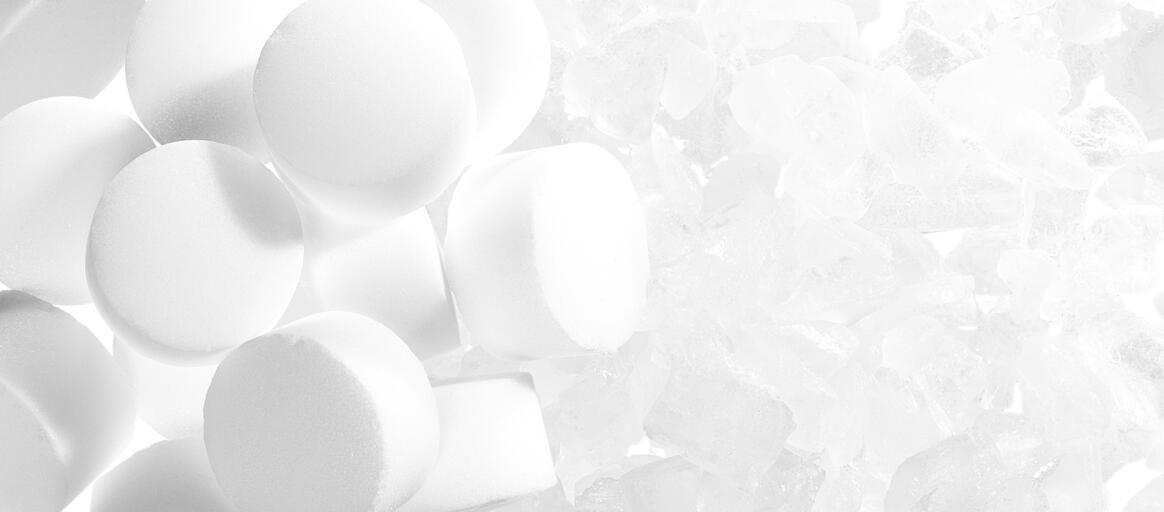
Salt tablets and salt crystals for water treatment

Salt tablets are made from vacuum salt extracted from underground mines, which is a multi-stage process requiring a lot of energy. However, crystals are pure salt produced by natural evaporation.

1. Salt crystals score better than the legal standard

The salt crystals from ZOUTMAN, SOFT-SEL CRYSTALS, meet European standard EN973A. For example, they meet the quality criteria for purity and the presence of heavy metals. In addition, they are completely additive-free and contain more than 99.8% sodium chloride, with the result that they score better than the requirements of the most stringent standards (> 99.4%).

They also contain far fewer insolubilities (0.01%) than the maximum allowed quantity (0.05%). The heavy metal content is even less than one tenth of that required by standard EN973A. In other words: SOFT-SEL CRYSTALS are made from food grade salt of very high quality.

 EN973 GRADE A*SOFT-SEL CRYSTALS®
NaCl≥ 99,4%99,8%
Anti-caking agent [Fe(CN)6]-4<20ppmNone
Insolubilities≤0,05%<0,01%
Moisture (dry salt)≤0,6%0,08%

* European standard for salt for the softening of water for human consumption.

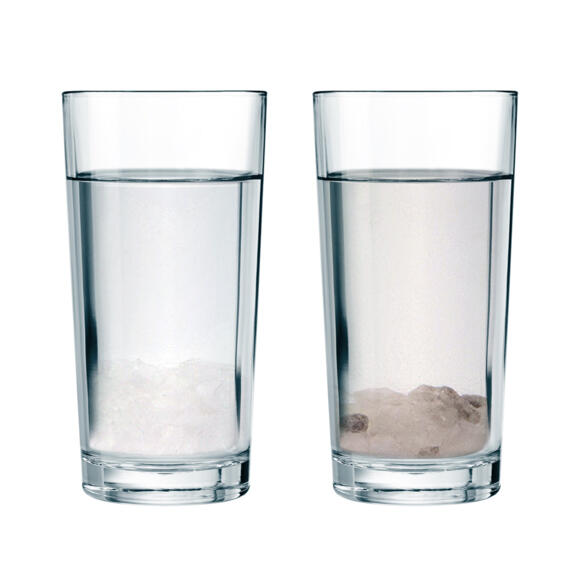
The purity of SOFT-SEL salt crystals is reflected in the clarity of the brine.

2. Salt crystals ensure a clear brine

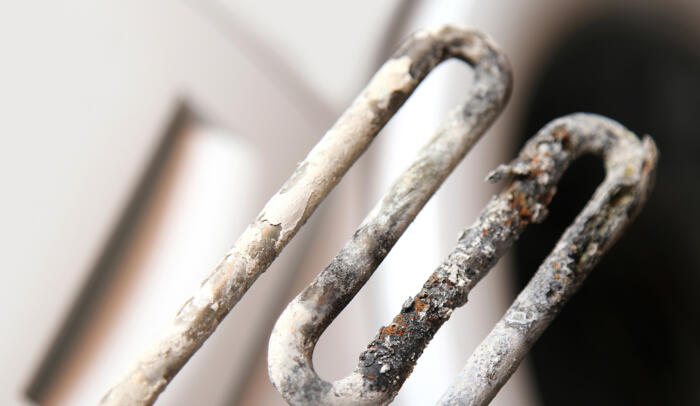
The purity of SOFT-SEL salt crystals is also reflected in the clarity of the brine. In the laboratory, the same quantity of SOFT-SEL salt crystals and salt tablets were dissolved in water, under controlled conditions. Both resulted in a pure, clear brine. And it's just as well: a cloudy, brown-coloured brine indicates inferior salt which you should avoid using in a water softener to ensure hassle-free operation and a long service life of the appliance.

Please note: variations in the quality of the water used may also affect the colour of the brine.

3. Salt crystals are champions in dissolving speed

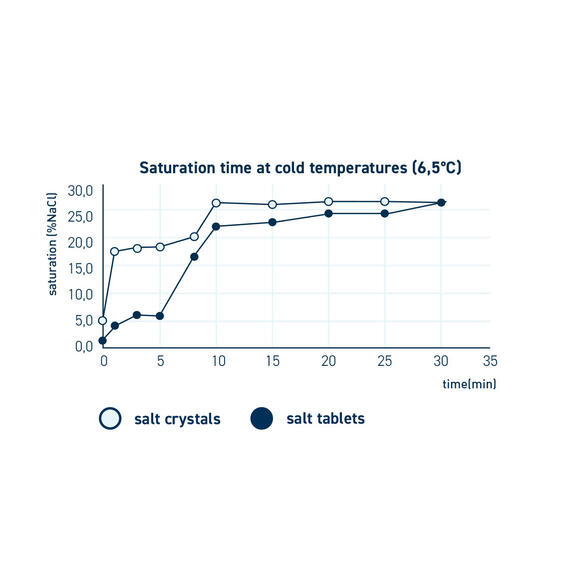
In applications with high water flow rates or large peaks in water consumption, the dissolving speed of salt is of crucial importance. The faster salt dissolves, the faster the water reaches its saturation point (+/- 27%), and thus the faster the water softener can do its job.

With SOFT-SEL CRYSTALS, the water is already saturated within five minutes. By comparison: with salt tablets this takes twenty minutes. During the cold winter months, salt also dissolves more slowly. Thanks to their high dissolving speed, salt crystals therefore handle these cold periods better than salt tablets.

The fact that salt crystals dissolve faster does not mean, however, that you use more of them. Once the water is saturated with salt, no more salt simply dissolves. The dissolving speed of SOFT-SEL CRYSTALS salt crystals therefore has no influence whatsoever on consumption.
The fact that salt crystals dissolve faster does not mean, however, that you use more of them. Once the water is saturated with salt, no more salt simply dissolves.

4. No clogging in your water softener

SOFT-SEL CRYSTALS owe their rapid saturation to their specific shape. As such, water can always make its way through the crystals, regardless of how they are positioned. On the other hand, lower quality salt runs the risk of bridging: the salt can clump together in the salt container, with the result that the water softener does not function properly (temporarily). Since CRYSTALS naturally have a hard granule structure, the chance that they disintegrate and form a salt sludge at the bottom of the salt container is very small.

"Crystal salt" owes its name to its coarse structure and crystalline appearance. SOFT-SEL CRYSTALS look similar to coarse rock salt, but the quality of these products is not comparable.  CRYSTALS are refined, food grade salt, while rock salt is usually unprocessed. So, when choosing a product, it is essential to obtain the correct specifications and check the clarity of the brine.

5. Environmentally-friendly

Last but not least: the ecological footprint of SOFT-SEL salt crystals is lower than that of salt tablets. Salt tablets are made from vacuum salt extracted from underground mines, which is a multi-stage process requiring a lot of energy. However, crystals are pure salt produced by natural evaporation.

Of course, you can continue to use salt tablets for water softening without problems. The analyses made by ZOUTMAN only confirm that SOFT-SEL CRYSTALS are an equivalent alternative that score even better on a technical, economic and ecological level.

The ZOUTMAN salt crystals are available in bags of 10 kg, 15 kg, 25 kg, big bags and in bulk. For water treatment installations using membrane electrolysis, we advise our SOFT-SEL PLUSS salt tablets.

SOFT-SEL® crystals vs. tablets

Comparison per tonne of softening salt produced: SOFT-SEL® CRYSTALS salt crystals (sea salt, EN973 grade A) have a water footprint of 0.18 m³ and a carbon footprint of 87 kg CO₂eq. Salt tablets (vacuum salt, EN973 grade A) have a water footprint of 11.3 m³ and a carbon footprint of 118 kg CO₂eq. Quality is equivalent; the environmental gain lies entirely in the production of the salt.

CRYSTALS
VS.
TABLETS
Source
Vacuum salt
Quality
EN973 type A
Water footprintper tonne, in production
11.3 m³
Carbon footprintper tonne, in production
118 kgCO₂eq

Calculate
your reduction

How much salt does your water softener use per year? Slide and discover the environmental impact you avoid by choosing SOFT-SEL® crystals.

The reduction lies in the production of the salt: sea salt requires far less water and energy to produce than vacuum salt.

8 bags of 25 kg
= 200 kg per jaar
1 bag1 tonne1,000 tonnes
2,224litres
Lower water consumption
15 full bathtubs
6.2kg CO₂eq
Lower emissions
52 km by car

Figures per tonne of salt produced: water footprint 0.18 m³ (crystals) vs 11.3 m³ (tablets) • carbon footprint 87 kg vs 118 kg CO₂eq. Conversion: bathtub ≈ 150 l • car ≈ 0.12 kg CO₂/km.

Product

This article was published in Salt for water softening